
The conversation goes at a much faster pace than the serving of payasam at a family sadya. Someone tells a story, there is laughter at the table and you join the laughter, not always understanding the context or the conversation. This is not uncommon for many Malayali adults. We can cope with simple phrases, but sustained conversation, local dialects, and fast-paced jokes can be difficult to follow. There are several practical reasons for this. English education, migrating out of the state for work and living outside Kerala for years deprive us of exposure. Malayalam remains a language that we listen to frequently but speak infrequently. With the passage of time, listening skills deteriorate. There is no question of loss of identity, but of lack of practice.
This blog looks at the reasons for this phenomenon, its impact on family bonds and culture, and what can be realistically done by adults to get back to Malayalam without shame, fear and making up all the jokes.
The Love For Language Never Fades
Rarely does Malayalam disappear abruptly from a person’s life. It requires time. When we were kids, we knew far more than what we could express since Malayalam was our native language and the language in which we had been scolded and cuddled. Everything that we study, know socially and will do professionally is in English. Speaking Malayalam is getting more difficult to train with time, however, one keeps hearing it.
That is why so many people say that they “know 70% and speak 20%”. One understands what people say about weather and plans on weekends, but when it comes to politics, poetry, or fast speaking about a sadya involving full local knowledge base, one gets lost.
The Cost of Nodding Along
There is a very strong emotion involved here, which unfortunately remains unappreciated. Just going through the scenarios in a family get-together is not only a bit embarrassing but ends up being staying on the outside of the room you were born into. Stories of your grandparents become half unheard. Jokes don’t entertain you. Phone calls with your parents don’t turn out to be memorable. For many adult Malayalis, this is not only the issue of speaking the language but the issue of their identity. And the good news is that this is not such a big problem to solve in adulthood as most people might believe it to be. Contrary to a child who still doesn’t have all the context – culture, vocabulary, songs and other phrases learned when he was a kid, the adult has all that. The only thing missing is – practice.
Journey From Passive Listener – Active Speaker
Moving from “I understand what you are saying, but I cannot reply on time” to “I understand you, but I have something better than you” demands a certain level of patience and determination.
• Learning conversation in language instead of reverting to the ABC charts designed for children
• A consistent and friendly approach, since fluency is built through practice, not memorization
• The experience of a mentor who understands the special humiliation of learning one’s mother tongue in adulthood
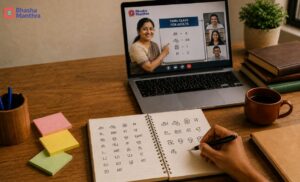
That is exactly what online Malayalam classes for adults can help you with. Adult language learning is entirely different from child language learning: It moves at your own pace, where you left off (“I understand everything, but I cannot make the words”), and respects your journey rather than patronizing you. The Malayalam speaking classes online, where you get to talk to your trainer in Malayalam, suits you best because it will prepare you for the situation you will face in reality; that is, the give and take process and instant corrections, without worrying about your family around you at the wedding. In fact, with a Malayalam-speaking trainer, you learn to think in Malayalam rather than translating everything from English to Malayalam.
Try This at the Next Family Event
There is no need to wait for a classroom setting before beginning to bridge the gap; you can start immediately. The following changes make things much better:
- Respond in Malayalam, regardless of how short the sentence. “Sheriyanu” or “enikku manasilayilla” (I didn’t understand) keep you involved in the discussion instead of taking you out of it.
- Ask people to slow down rather than translate into English. “Pathukke parayamo?” (can you say that slowly?) keeps your ears tuned instead of dragging you back into English.
- Choose one elderly person as your conversation partner. Your grandparents and elderly relatives are happy to assist and are likely to speak more slowly with repetition.
- Pay attention to all of the words you know. Names for foods and family members and other phrases you use to bless people are some of the many words of Malayalam you already know.
You Haven’t Lost the Language, You’re Away from It
One of the most important pieces of advice is that not being able to speak a language you know does not mean failure. Your ears have been trained, the culture is instilled in you, all it takes now is practice, patience, and courage to speak up.